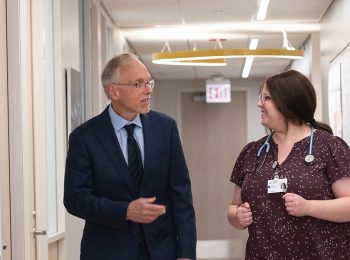

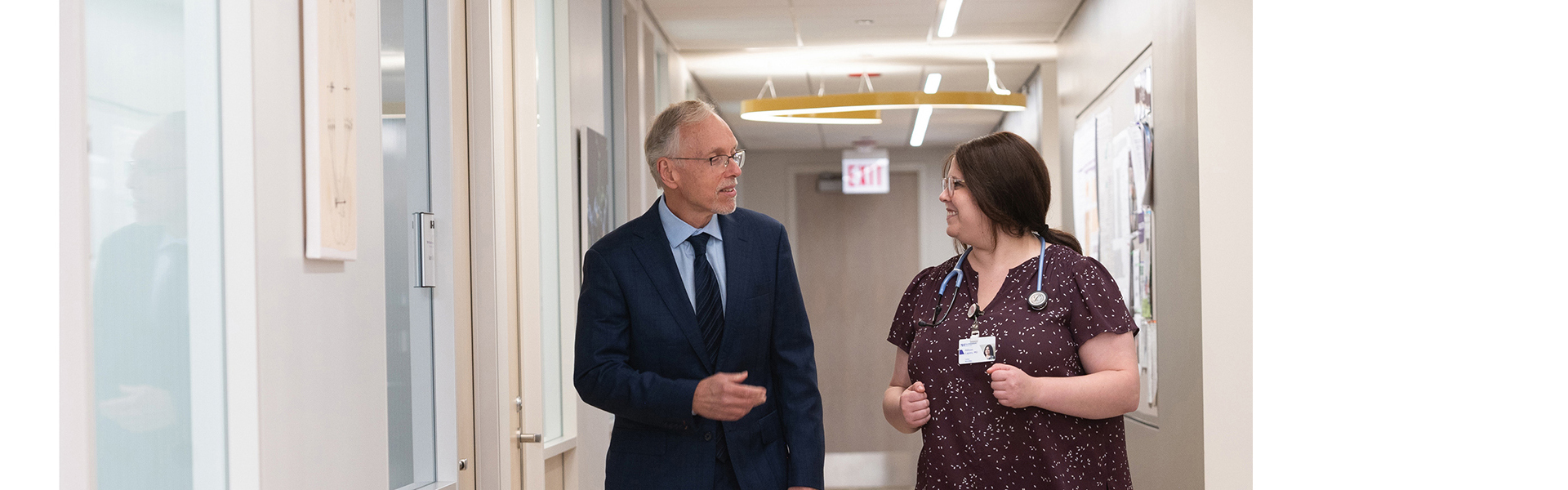


Kate Marko, MD, is one of the OB/GYN residents currently on rotation at John Stroger Hospital. A new Northwestern program enables McGaw residents to get more broad-based training, spending 30 percent of their time at Stroger.
“Providing care to indigent and underserved populations is essential to educating medical students and residents and serving the broader community,” says J. Larry Jameson, MD, PhD, vice president for medical affairs and Lewis Landsberg Dean. “We want affiliations that have a strong commitment to underserved populations so students and residents can maintain and develop their commitment to community service.”
The transition of educational programs from Evanston Northwestern Healthcare (now NorthShore University Health System) provides a unique opportunity to further diversify training experiences. Dr. Joshua Goldstein, program director of child neurology at Children’s Memorial Hospital, led a graduate medical education (GME) subcommittee in coordinating these efforts. He had support from Doctors Raymond Curry and Sharon Dooley, president and vice president of Northwestern McGaw, along with assistance from directors and department chairs.
Forty new residents were added to existing rotations at NMH and nine at CMH – “a considerable investment on the part of both institutions, given Medicare ‘caps’ and limited Federal funding for pediatric GME programs,” explains Dr. Raymond Curry, dean for education.
Of the 40 resident positions at NMH, five were psychiatric rotations, which included two brand-new rotations. A senior administrative resident helps triage ER patients four nights a week to shorten wait times for identified psychiatric patients and medical/surgical patients with psychiatric symptoms, increasing the number of residents on the consultation/liaison service. A senior resident has been added on the inpatient unit to supervise more junior residents. In addition, the Jesse Brown VA Hospital added three rotations, two in addiction training and one community psychiatry rotation utilizing telepsychiatry.
Meanwhile, the obstetrics and gynecology program began rotating four residents to John H. Stroger Hospital of Cook County, in addition to increased involvement at Stroger in the urology, neurosurgery, ENT, and orthopedics programs. “Northwestern and McGaw have a long history there,” explains Dr. Curry. “Many alumni have fond memories of their training days at ‘the County.’ And we’re very happy to be collaborating again to our mutual benefit.”
More Diverse Training
While securing commitments with current affiliates, Northwestern also actively sought relationships with other institutions. What they discovered were a number of opportunities to support hospitals that were excited about sponsoring and teaching residents. This included MacNeal Hospital, a 427- bed accredited teaching hospital serving the southwest side of Chicago, where four new general surgery positions were added; and Methodist Hospital in Gary, Ind., where three new positions in emergency medicine provide residents with community hospital experience.
“These new resources all represent wonderful diversity of patient populations,” says Dr. Dooley. “Residents are seeing different disease states in different stages. For example, at Methodist where there’s primarily an indigent population, people who typically go to the ER don’t get the best preventive care so they present with different illnesses than many of our residents are accustomed to seeing. In this rich learning environment, residents can really serve patient needs as they develop skills in negotiating unfamiliar systems. It’s enormously rewarding for them.”
The dean of GME programs continues, “Through the Stroger OB/GYN rotations, our residents are gaining experience in colposcopy procedures they were not getting at Prentice Women’s Hospital. Over the first four months, the presence of our faculty and residents in this once understaffed colposcopy clinic eliminated a backlog in patient care.”
Adds Dr. Magdy Milad, the Northwestern OB/GYN program residency director, “We began with the colposcopy clinic pilot in the spring, and by summer, we had placed four full-time residents at Stroger. At that time, we started talking about an integrated residency program. As a result, Stroger closed their struggling OB/GYN residency and replaced it with the Northwestern program.” Over the next four years, the residency will become the second largest OB/GYN training program in the country, expanding to 12 positions per year, with residents receiving 70 percent of their training at Prentice Women’s Hospital and 30 percent at Stroger. In addition, third-year medical students will begin six-week clerkships in July 2010 and fourth-year students can take electives.
Map of Residency Sites
The Northwestern McGaw Center for Graduate Medical Education sponsors 79 accredited programs, serving more than 1,000 residents and fellows. Northwestern University, Northwestern Memorial Hospital, Children’s Memorial Hospital, and the Rehabilitation Institute of Chicago, along with its member organizations, have been collaborating through McGaw for more than four decades.
New and Expanded Site Affiliates
MacNeal Hospital |
Methodist Hospital |
Stroger Hospital |
Glowing Feedback
Early assessments of the impact of the residency program changes is quite positive. The surgery residents now rotating at MacNeal Hospital have summarized their experience to date for the GME Committee and “find it a very supportive and collegial learning environment, with ample opportunity for ‘bread and butter’ surgical experience,” explains Dean Curry.
Dr. Dan Schwartz, a fourth-year orthopedics resident, was able to complete six-week rotations in hand service and trauma at Stroger. “I saw a lot of pathology and was exposed to more trauma cases and different attendings with their own unique approaches. Being in the operating room eight to 10 hours a day, I grew comfortable making decisions, always knowing there was a safety net. I got to do damage control, getting in and out quickly to benefit the patient. It was stressful sometimes, but the teachers were so patient and experienced that they made it fun. Overall, this experience made me grow into a more skilled surgeon.”
And at Methodist Hospital in Gary, feedback from emergency medicine residents is equally positive. “Residents aren’t fond of the drive, but they love the rotation because they get realistic community medicine experience and exposure to true patient care,” says Dr. Jamie Collings, program director of the emergency medicine residency. “And our graduates who are overseeing the program like the challenge of getting patients the resources they need.”
Concludes Dean Curry, “We have been able to create new affiliations that will greatly diversify and enhance the educational experience for Northwestern residents and medical students and expand our commitments to Chicago communities in very meaningful ways.”
Online Extra
Stroger and Northwestern “Marriage” Enriches OB/GYN Residency Program
The buzz on the resident interview trail began building in September 2009 as medical students around the country who were considering careers in obstetrics and gynecology started talking about the new opportunities at Northwestern. With the inclusion of the John H. Stroger, Jr. Hospital of Cook County in the Northwestern McGaw obstetrics and gynecology program, successfully marrying the public with the private, the second largest U.S. OB/GYN residency was created.
Resident candidates were provided with a description of the Northwestern plan before they arrived for interviews. “I can tell you much of the conversation with candidates has been related to the integration and how excited they are,” says Magdy Milad, MD, MS.
“Ever since I became OB/GYN residency program director, I’ve wanted a significant component of the resident experience to be with the un- and underinsured,” he explains. “I did a medical mission overseas about a year ago, but in this new setting and opportunities, it’s not necessary to leave the country to help people who are truly in need. In Chicago, we’re better equipped to improve the overall quality of care because we know the resources of the city and we’re here all of the time -- not just for a week or two.”
Although Stroger already had an OB/GYN residency, it was struggling to meet Residency Review Committee (RRC) requirements to maintain the program. In fact, Stroger had received unfavorable media attention in years past due to patient care backlogs for women who needed gynecological treatment.
“We tried to find avenues to augment the resident training experience and this seemed like a good place to start,” says Dr. Milad. In spring 2009, Northwestern residents and faculty began helping at Stroger’s Fantus Clinic, a facility that treats 1500 gynecologic patients a year. By summer, there were four full-time Northwestern McGaw residents working at Stroger. Now 12 to 15 residents have worked one or two rotations there. When they started, there were approximately 700 women on a six- to nine-month wait list to have their abnormal PAP smears evaluated. Among other things, the Northwestern residents and faculty performed loop electrosurgical excision procedure (LEEP), a treatment to address more advanced pre-cancerous cell growth in the cervix, a skill that many residents weren’t getting enough opportunities to learn at Prentice Women’s Hospital. Four months later, the backlog of patients was eliminated, and Stroger reached out to their feeder clinics to encourage more patients to seek treatment at Fantus.
“When we began helping at the clinic, we also started talking about our mutual interest in developing a combined residency,” explains Dr. Milad. “We agreed this was a good idea. They decided to phase out their program and we began the process of integrating our residencies.”
Resident Perspective
“The most consistent report I get from residents is that they feel like we need to be there for these patients,” says the program director. “While it can be challenging at times because of institutional cultural differences, they are learning a good deal. With disease states that are less often encountered at Northwestern, including advanced cervical disease, large myomas, and severe endometriotic disease, residents agree that the experience provides a broad-based exposure to women’s health. Overall, residents believe this training will make them better doctors.”
In July, second- and fourth-year Stroger residents began expanding their experiences in obstetrics, reproductive endocrinology, and simulation training through rotations to Prentice Women’s Hospital. The reciprocal experiences have provided more cases and a wide range of acuity to both sets of training residents. By fall, Northwestern residency and clerkship directors received their attending privileges at Stroger to foster greater educational coordination and oversight. Faculty and residents are enthusiastic about the emerging relationship.
Making it Official
Before the development of a formal relationship could happen, the Obstetrics and Gynecology Residency Review Committee, the arm of the Accreditation Council on Graduate Medical Education that oversees training in the specialty, needed to approve the plans to phase out the Stroger residency and expand the Northwestern program. Northwestern developed an addendum, with Stroger weighing in on the benefits to residents and patients. “Not only did the review committee approve these changes, they gave us a four-year accreditation cycle (it is unusual for such a sweeping change to be approved for a full cycle), which was really a testament to how strongly they felt about the application,” explains Dr. Milad.
Over the next three years, Stroger will phase out its current group of twelve residents. At the same time, Northwestern will expand its incoming classes of residents to 12 and by 2018 to 18. Residents will split their training between Prentice and Stroger, with 70 percent spent at Prentice. In addition, the Feinberg School of Medicine has selected Stroger as a core training site for third-year medical students.
“We have a significant commitment and support from Stroger, which sees overwhelmingly the opportunity to benefit from our patient safety protocols and our well-developed treatment processes,” he says. “We also have support from Dr. Fidel Abrego, the site director at Stroger and now the associate program director at Northwestern.”
In addition, to help improve the resident training experience, Northwestern Memorial Hospital has made an annual six-digit financial commitment to enable Stroger faculty participation in national meetings and local CME conferences, to develop ‘smart’ classrooms and web conferencing capabilities, and to purchase educational software and equipment. Stroger faculty will have library access to electronic resources and will be included in faculty development programs offered by the medical school and the NU Searle Center for Teaching Excellence.
“On the horizon, we will address a similar backlog of patients with non-surgical gynecological issues,” explains Dr. Milad. “We are actively exploring developing a procedure room to provide interventions that don’t need general anesthesia and are seeking a donor so we can convert an existing OR into a designated area for gynecological surgery.”
There are many opportunities to enrich the OB/GYN resident training experience and improve patient care. Northwestern needs to look no further than its own back yard.